
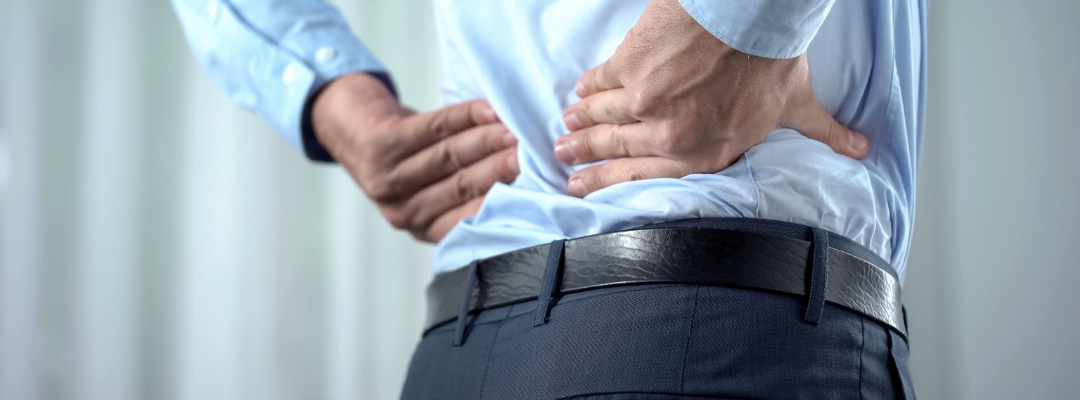
What is a Slipped Disc?
A slipped disc refers to an intervertebral disc of the spine that has lost its normal shape and/or consistency. The altered shape occurs when the disc’s soft inner material (nucleus pulposus) bulges or leaks out of its external fibrous covering (annulus fibrosus). Your intervertebral discs are spinal shock absorbers and help transfer loads evenly. Several medical terms, such as herniated, ruptured, torn, bulged, or protruding disc may be used interchangeably with a slipped disc.
Herniation commonly occurs toward the side and back of the disc, where the annulus fibrosis is relatively thinner. This part of the disc is also close to the spinal nerve roots and can cause:
- Mechanical compression of these nerve roots, which may result in nerve pain and/or weakness in your arm or leg, depending on the site of compression
- Chemical irritation of the nerve roots due to the leaking of inflammatory substances from the nucleus pulposus
How a slipped disc occurs
The two most common causes for a herniated disc are:
- Natural degeneration of the disc, which causes the nucleus pulposus to become less hydrated and weaken with age.
- Trauma to the disc, which may occur due to lifting a heavy load using incorrect posture or from external forces, such as, a whiplash injury.
A common myth is that pain is only associated with the back or area of herniation. In fact, herniated discs have the potential to cause pain in the back, neck, and even radiating down the buttocks, thighs, knees and feet, a condition known as sciatica. There may also be numbness or tingling (pins and needles), and pain can be aggravated by simple movements or even sneezing or coughing.
Pain is caused by the herniated disc pressing on the nerves within the spine, and some people may only experience pain down one side of the back, depending on the direction that the disc has herniated. It is important to note that not all people will experience pain. In some cases, symptoms of herniated discs may resolve on their own accord. In other cases, you may need to seek advice from your physician.
Symptoms of a herniated disc may be signs of a more serious condition. If you experience numb or weakness in both legs, in addition to loss of bladder or bowel control, it is important to seek medical care, as this may be sign of a serious condition known as cauda equine syndrome.
Look into your daily routine to see if there are any patterns or triggers for your back pain. If you are not seeing my improvements in your symptoms make sure to check out our back pain booklet or better yet book in with us today for a face to face appointment!
At Moore Performance Ltd we carry out a thorough assessment to discover the cause of your back pain. We will then explain it in non-complicated language and suggest appropriate treatment methods to get you back to feeling pain free as soon as you can. If one of our treatment options is not appropriate then we will be happy to refer you on to the appropriate specialist.
Get in touch with us:
 01480775912
 info@mooreperformance.uk

Click Here For Your Free Back Pain Report
